Welcome to our website!


What is Visco-Elastic Tape and How Does It Work?
What is Visco-Elastic Tape and How Does It Work?
Visco-elastic tape is a revolutionary anti-corrosion material designed specifically for irregular surfaces like flanges, valves, pumps, and fittings. Unlike traditional coatings that harden and crack over time, visco-elastic tape never cures, self-heals from minor damage, and requires no sandblasting — making it the ideal solution for complex pipeline corrosion challenges.
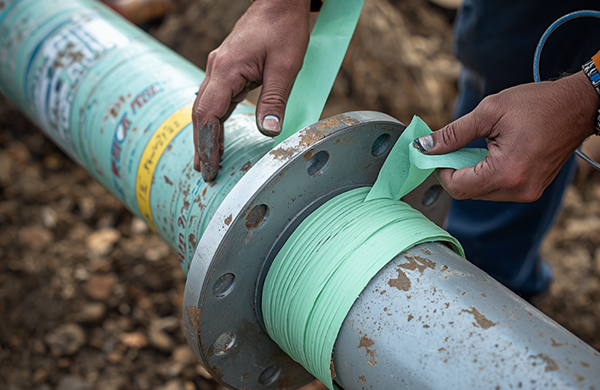
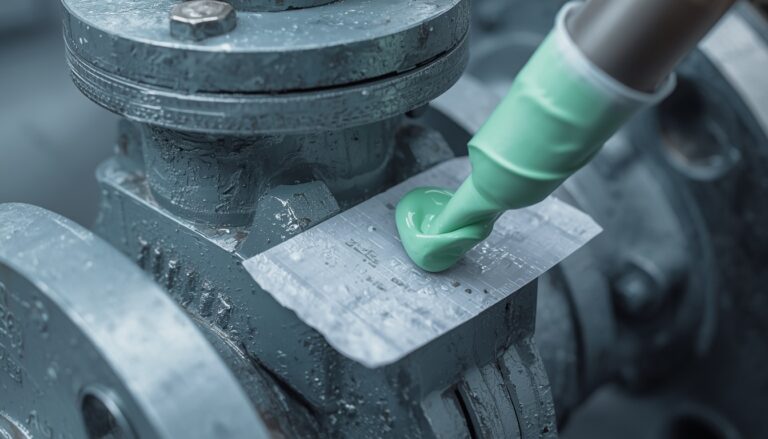
[Image: Visco-elastic tape being applied on a flange — showing how it conforms to irregular surfaces]
What Is Visco-Elastic Tape?
Visco-elastic tape is a polyisobutylene (PIB)-based anti-corrosion material. It is supplied in roll form with a removable release liner. When the liner is removed and the tape is applied to a prepared surface, it forms a permanent, self-healing protective layer that effectively seals out moisture, oxygen, and corrosive agents.
The term “visco-elastic” refers to the material’s unique physical properties — it behaves like both a viscous liquid and an elastic solid. This dual nature allows the tape to flow into gaps and irregularities over time (viscous behavior) while maintaining structural integrity and adhesion (elastic behavior).
Unlike epoxy coatings, heat shrink sleeves, or polyethylene tapes, visco-elastic tape never cures. It remains soft, flexible, and fully active for the entire service life of the asset — typically 25 years or more.
How Does Visco-Elastic Tape Work?
The effectiveness of visco-elastic tape comes from its advanced PIB chemistry. Three key properties make it work:
1. Cold Flow (Viscous Behavior)
Cold flow is the gradual movement of the tape material over time. Once applied, the tape slowly flows into scratches, surface irregularities, and gaps — even microscopic ones. This creates a perfectly sealed interface between the tape and the substrate, leaving no pathways for moisture or oxygen to reach the metal surface.
Unlike heat shrink sleeves that rely on external heat to conform, visco-elastic tape flows naturally at ambient temperatures. No heating equipment is required.
2. Self-Healing
If the tape is punctured, scratched, or otherwise damaged during handling, installation, or service, the self-healing property automatically repairs the damage. The surrounding material flows into the damaged area, sealing it completely. This significantly reduces the risk of corrosion starting from coating defects — one of the most common failure modes of traditional coatings.
Self-healing is not a surface treatment or additive. It is an inherent property of the PIB polymer matrix.
3. Non-Curing (Permanent Flexibility)
Visco-elastic tape never hardens or becomes brittle. Traditional coatings cure over time — they cross-link and eventually crack under mechanical stress or temperature cycling. Visco-elastic tape does not cross-link. It remains permanently flexible, adapting to pipe movement, thermal expansion, and vibration without cracking or losing adhesion.
This non-curing nature also means the tape does not shrink or pull away from the substrate over time, eliminating a major cause of coating failure.
Why This Matters for Pipeline Corrosion
Pipeline corrosion is a multi-billion dollar problem. Traditional coatings fail for several predictable reasons:
- Cracking — Hard coatings crack under mechanical stress or temperature change.
- Disbondment — Adhesion fails over time, especially under cathodic protection.
- Holidays — Pinholes and voids in the coating allow moisture ingress.
- Poor conformability — Rigid coatings cannot fully cover irregular surfaces.
Visco-elastic tape directly addresses each of these failure modes:
- Cold flow eliminates holidays by filling microscopic voids.
- Self-healing repairs damage automatically.
- Non-curing prevents cracking and disbondment.
- High conformability perfectly wraps around flanges, valves, and fittings.
Additionally, visco-elastic tape is fully compatible with cathodic protection (CP) systems. It does not shield CP current and has excellent resistance to cathodic disbondment — a common issue with many traditional coatings.
Key Advantages Over Traditional Coatings
- No Sandblasting Required — Simple St2 hand tool cleaning is sufficient. This reduces surface preparation time and cost by up to 70%.
- No Heating — Cold application means no propane torches, no heat guns, and no hot work permits.
- No VOC — 100% solids material releases zero volatile organic compounds, safe for applicators and the environment.
- No Curing Time — Backfilling or service can begin immediately after application.
- Long Service Life — Proven performance for 25+ years in buried and submerged service.
- Forgiving Application — The material is easy to apply and tolerant of less-than-perfect surface conditions.
Where Is Visco-Elastic Tape Used?
Visco-elastic tape is ideal for a wide range of pipeline and industrial applications, especially where irregular shapes or complex geometries make traditional coatings difficult to apply.
- Flanges, valves, and pumps — Irregular surfaces that rigid coatings cannot properly cover.
- Pipe repairs and rehabilitation — Quick, cold-applied repair for damaged coatings.
- Elbows, tees, and other fittings — Complex shapes requiring conformable materials.
- Casing ends and penetrations — Sealing where pipes pass through casings or walls.
- Buried pipeline accessories — Anodes, test stations, and other attachments.
- Offshore and marine applications — Splash zone and subsea corrosion protection.
How to Apply Visco-Elastic Tape
Application is straightforward and requires no special training or equipment:
- Surface preparation — Clean the surface to St2 using hand tools or mechanical brushes. Remove loose rust, dirt, oil, and moisture.
- Fill deep cavities (if needed) — For flanges with deep bolt recesses or sharp corners, apply visco-elastic paste first to create a smooth, level surface.
- Remove the release liner — Peel back the release liner from the tape.
- Wrap the tape — Wrap the tape around the component with a minimum 55% overlap. Apply firm hand pressure to ensure intimate contact.
- Press and finish — Press the tape end firmly. No heating, no waiting — the installation is complete.
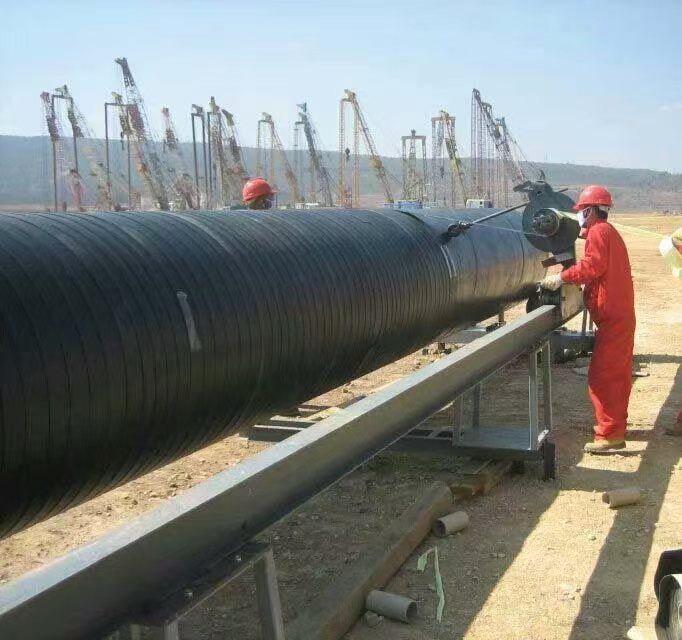
For large-diameter pipes or high-volume applications, mechanical wrapping tools can be used to speed up installation while maintaining consistent overlap and tension.
Standards and Compliance
Visco-elastic tape manufactured by Jiayu meets or exceeds international standards, including:
- ISO 21809-3 — Petroleum and natural gas industries — External coatings for buried and submerged pipelines.
- NACE SP0109 — Application of tape coatings for external corrosion protection of pipelines.
- EN 12068 — External organic coatings for the corrosion protection of buried or immersed steel pipelines.
Third-party test reports are available upon request, including cathodic disbondment testing (28 days, 65°C), peel strength, volume resistivity, and self-healing verification.
Learn More About Visco-Elastic Solutions
Our visco-elastic tape is available in multiple thicknesses (1.8mm to 2.5mm) and widths (50mm to 300mm). Custom sizes can be manufactured for specific project requirements.
Need Expert Advice for Your Pipeline Project?
Every pipeline project has unique conditions — different temperatures, soil compositions, cathodic protection levels, and mechanical stress requirements. Our technical team can help you select the right visco-elastic solution for your specific application.